Achieved daily, by pumps — and it stops being achievable long before she looks in trouble.
Preservation & Restoration · 04
The Problem With Keeping a Century-Old Ship Afloat
Achieved daily, by pumps — and it stops being achievable long before she looks in trouble.
01A ship that looks stable can be losing the argument underwater
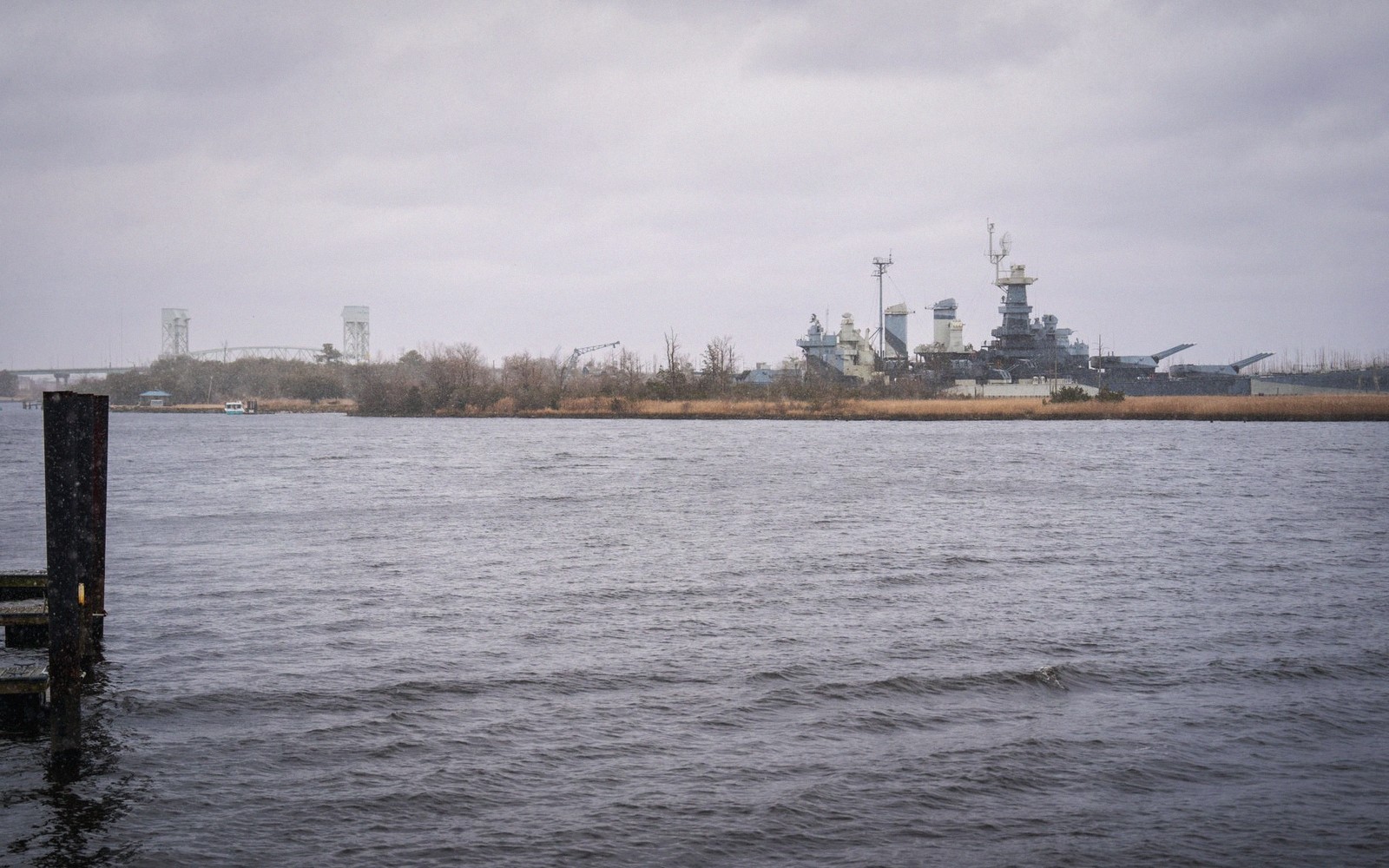
A museum ship at her berth is a convincing object. She sits at a fixed waterline, her topsides painted, her guns trained at a comfortable angle for photographs. Nothing about her visible geometry suggests crisis. That is precisely the problem: the hull below the waterline is making an argument with physics every hour of every day, and the score is not displayed anywhere you can read it from the dock.
The argument is simple in outline. Steel immersed in salt water corrodes. Corrosion thins plate. Thin plate admits water. Water admitted faster than it can be pumped out means the ship is lost. Every preserved battleship afloat anywhere in the world is somewhere on that continuum — not safely clear of it, simply somewhere along it — and where exactly on it she sits is never entirely certain because most of the hull cannot be seen without hauling the vessel out of the water. For a ship of USS Texas's age and size, that is not a trivial operation.
Texas was laid down in 1911, launched in 1912, and commissioned in 1914. She is a riveted hull — plates lapped and joined by hundreds of thousands of hot-driven rivets, no continuous weld seam anywhere in the original structure. Riveted construction was the dominant shipbuilding technique of her era, and it is durable in its own way: a riveted joint can shift slightly without catastrophic propagation of failure, unlike a cracked weld. But every rivet hole is a potential pathway. Every caulked seam between overlapping plates is a potential pathway. Over a century of immersion, with the original coatings long gone and successive protective layers applied over deteriorating steel rather than bare metal, the number of potential pathways is very large.
Key facts · terms used on this page
Plate 03- bilge pump
- mechanical pump removing accumulated water from the lowest hull spaces
- splash zone
- hull area at and just above the waterline; high corrosion risk due to oxygen exposure
- galvanic corrosion
- accelerated metal loss where dissimilar metals contact in a conductive electrolyte
- void space
- enclosed compartment within the hull structure, not used for machinery or storage
- plate renewal
- removal of deteriorated hull plating and replacement with new steel
02What pumps actually do — and what they cannot
The practical answer to ingress on a ship that cannot be fully sealed is pumping. Texas has maintained a system of bilge pumps that run continuously, moving accumulated water out of void spaces and compartments that take on seepage. This is not a makeshift emergency measure; it is a designed-in expectation of how the ship is kept. The pumps are the margin. The question is always whether the margin is adequate, and whether it is narrowing.
What pumps cannot do is repair the steel they are compensating for. Every gallon removed is a gallon that found a way in, and the path it took is still there, probably slightly wider than it was. Pumping buys time. It does not restore material. The distinction matters because it sets a horizon: at some rate of ingress, no pump arrangement aboard the ship can keep pace, and that rate is approached gradually and invisibly. A ship does not announce that she is approaching her pump limit. She simply sits a little lower, takes on water a little faster, and the pumps run a little harder — until one day the margin is gone.
For a ship of USS Texas's age and size, that is not a trivial operation.
Texas came close to that limit. By the early 2010s, her condition was serious enough that the question of how much longer she could be maintained afloat at her berth near the San Jacinto battleground — where she had been a museum ship since 1948 — was no longer theoretical. The pump systems were working hard. Structural surveys were producing findings that could not be addressed from the outside. The only way to do what needed doing was to get her out of the water entirely, and to do that, she had to be moved: Her home berth had no dry-dock facility capable of receiving her.
1911year Texas was laid down
1912year Texas was launched
1914year Texas was commissioned
1948year Texas became a museum ship at her Galveston berth
03The geometry of deterioration
Corrosion on a hull like Texas's does not distribute itself evenly, and that unevenness is part of what makes assessment difficult. Areas of the hull that are perpetually wet but not fully immersed — the splash zone near the waterline — tend to corrode faster than deeply immersed plate, because oxygen availability is higher there. Areas where dissimilar metals are in contact corrode faster still, the galvanic circuit running continuously as long as the electrolyte — salt water — is present.
Texas also carries a structural complication that is essentially unique to her: the blisters. These bulges, added in the 1920s to the hull's flanks, increased her beam substantially and changed the pattern of what was exposed and what was enclosed. The original hull plating that lies inside the blister structure sits in a void space — sometimes flooded, sometimes not, sometimes partially drained, sometimes holding standing water for years at a time. That plate was not designed to be an interior surface. Its protective treatment was applied when it was the exterior of the ship. Decades inside the blister void, in conditions that were never fully controlled, did things to that steel that nobody fully knew until the hull was opened up.
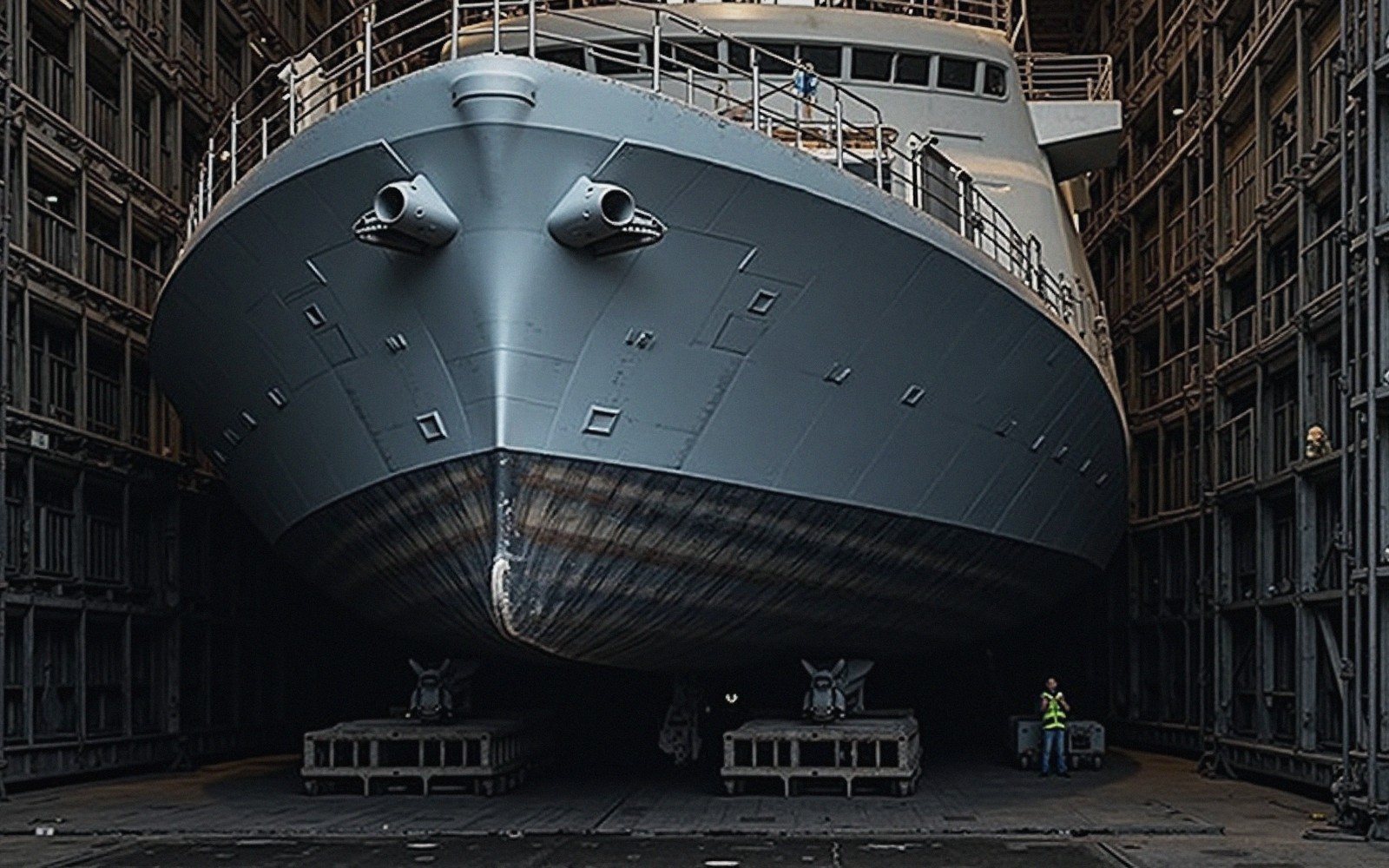
When Texas was eventually moved to dry dock — a process that required an unpowered tow because she has no operable propulsion and no usable shaft line — the condition of the steel under and within the blisters confirmed what surveyors had suspected: extensive plating required renewal. Not cosmetic treatment. Not recoating. Removal and replacement. The original plate in multiple sections was beyond the threshold at which any surface intervention could extend its life further.
The renewal work that followed — cutting out deteriorated plate and welding in new steel — is not straightforward on a historic hull. Every plate removed is a decision about how much of the original material the ship can lose before the question of what exactly is being preserved becomes uncomfortable. But the engineering answer is blunt: plate that cannot hold water is not preservation; it is a countdown. New steel in the right places is what allows the rest of the original structure to remain.
Chronology · stated as record
- 1911–1914construction and commissioning of Texas
- 1920sblister addition, widening her beam
- 1948arrival at the San Jacinto battleground as a museum ship
- early 2010shull condition assessed as critical; pump margin under serious pressure
- 2010s–2020sdry-dock tow, structural survey, and plate renewal programme
| Stage | What it settles |
|---|---|
| 01 · Survey | What thickness is left, measured rather than estimated |
| 02 · Patch | Whether pumps and cofferdams can hold the line meanwhile |
| 03 · Tow | Whether an unpowered hull can reach a dock at all |
| 04 · Dry dock | The first unobstructed look at the underwater body in decades |
| 05 · Plate renewal | Which plate comes out, and whether new work is riveted or welded |
| 06 · Refloat | Where she sits afterwards, and how exposed that berth is |
04The daily arithmetic of survival
What keeps Texas afloat in the long run is not any single repair campaign but the maintenance of a viable relationship between ingress and extraction — between the water that finds its way in and the pumps and sealed surfaces that prevent it from accumulating. That relationship has to be actively managed, continuously, by people who understand what they are looking at and have the resources to act when the numbers change.
Museum ships fail when the arithmetic goes wrong and nobody can afford to fix it — when deferred maintenance compounds until the pump margin is gone, the hull is beyond economic repair, and the only questions left are whether she goes to the bottom at her berth or gets sold for scrap. Several significant vessels have ended that way. Texas has not, partly because of sustained attention and partly because the condition was caught — barely in time — before it became unrecoverable.
Written from published engineering and heritage sources. Where a figure is not documented, this archive describes the engineering rather than asserting a number.
Subjects and places referred to
Galveston
Referred to on this page
Texas Gulf Coast city; where Texas was towed for dry-dock repairs
USS Texas (BB-35)
Referred to on this page
New York-class dreadnought battleship, the subject of this archive