Thousands of overlapping plates, hundreds of thousands of rivets, and not one drop of sealant.

The Ship · 01
How a Riveted Hull Actually Holds Water
Thousands of overlapping plates, hundreds of thousands of rivets, and not one drop of sealant.
Image reference: en.wikipedia.org/wiki/USS_Texas_(BB-35)
01Steel on Steel, Plate on Plate
There is a temptation to picture a riveted hull as something held together by brute force — as though the rivets are simply pins driven through a stack of metal, keeping it from flying apart. That picture is not wrong, exactly, but it leaves out the thing that actually keeps the water on the outside: controlled compression. A riveted seam does not seal against the sea because the rivets plug any gaps. It seals because the rivets pull the plates together hard enough that steel presses against steel across the full width of the lap, leaving no path the water can follow. The joint is a clamp, not a plug.
Understanding that distinction matters if you want to understand why riveted hulls age the way they do, why they leak when they leak, and what it took to keep a ship like USS Texas watertight across more than a century of service. Her hull carries millions of pounds of metal in overlapping shell plating, and every joint in that plating depends on that same principle of sustained clamped contact. The moment that contact weakens anywhere — through corrosion, through working, through the slow fatigue of steel that has flexed through uncountable seaways — the seal begins to fail.
To see how it works, you have to start with the geometry of how plate is laid against plate.
Key facts · terms used on this page
Plate 03- strake
- longitudinal ribbon of shell plating running the length of the hull
- lap joint
- joint where one plate edge overlaps another and is riveted through both
- butt joint
- end-to-end plate joint, typically backed by a butt strap
- butt strap
- doubling strip bridging the gap at a plate butt, riveted to both ends
- faying surface
- the mating face of a plate or structural member at a joint
- caulking iron
- chisel-like tool used to work a plate edge into tight contact
02The Lap, the Butt, and the Driven Rivet
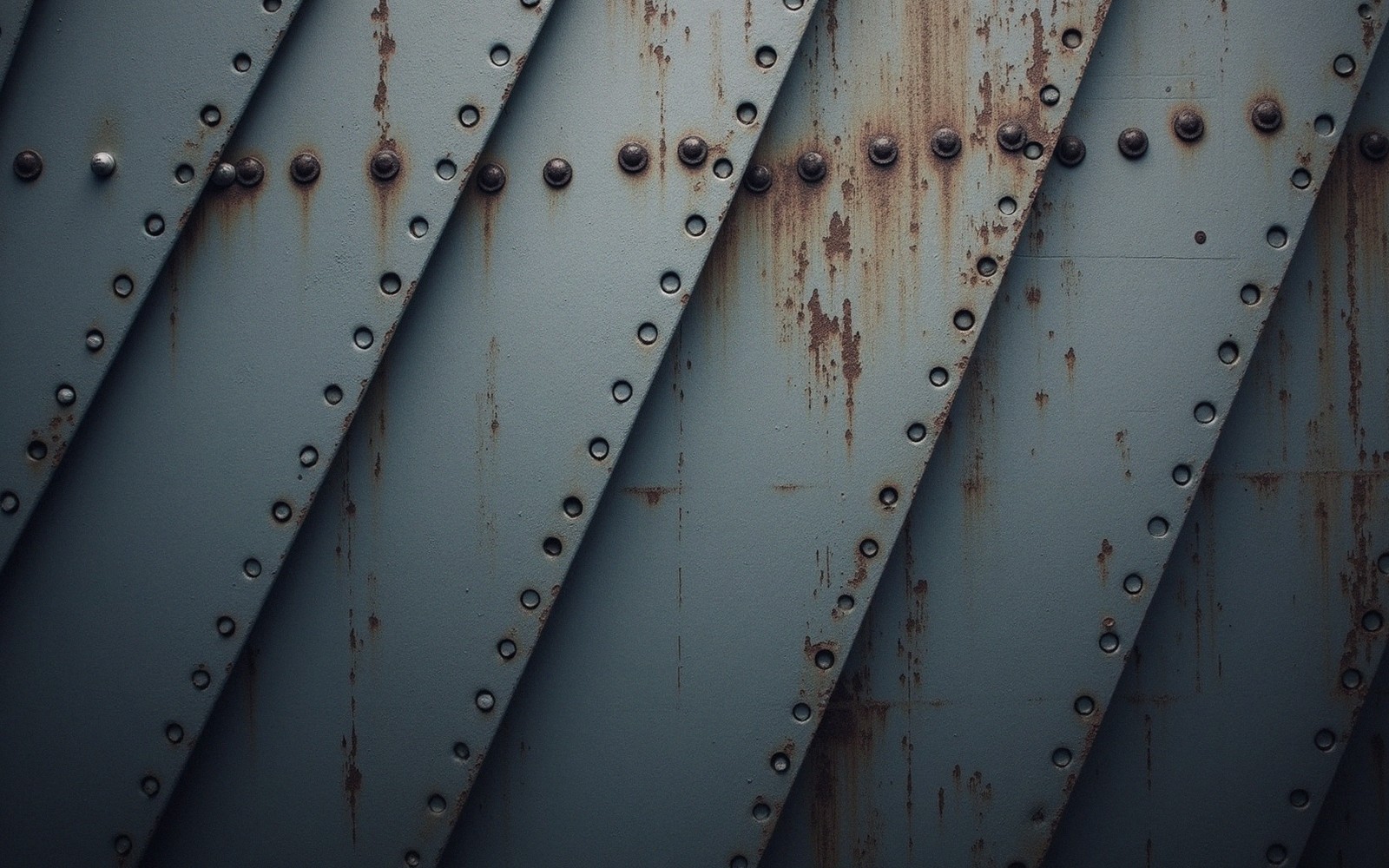
Shell plating on a hull of Texas's era is arranged in strakes — longitudinal ribbons of steel running from bow to stern, each strake overlapping the one below it along a lapped seam, and meeting the adjacent plate in the same strake at a butt joint. The lap is the structural and watertight joint: one plate edge rides over the other, and the rivets driven through the overlap pull them together. The butt is typically backed by a butt strap — a narrow doubling piece bridging the gap between plate ends — and is riveted in the same way.
The rivet itself is a headed steel shank, supplied slightly longer than the combined thickness of the plates it will pass through. Driven hot — at a temperature where the steel is plastic but not liquid — it is held from one side by a dolly bar while a riveter's hammer or pneumatic gun upsets the protruding end into a second head. As the rivet cools and contracts, it shortens along its length, drawing the two heads toward each other and clamping the plates between them. The clamping force is not modest: a correctly driven rivet in hull plating exerts tons of compressive load across the joint face, and it is that compressive load, sustained by the rivet's residual tension, that does the sealing.
To see how it works, you have to start with the geometry of how plate is laid against plate.
No caulking compound, no mastic, no sealant of any kind is applied inside the joint itself — not between the overlapping plate faces. That is not an omission; it is the design. Introducing a compressible material into the joint would reduce the contact pressure and undermine the very mechanism the joint relies on. The steel-on-steel contact must be unmediated. What shipbuilders did apply, in some joints, was a light coating of red lead paint to the faying surfaces — the surfaces that would be in contact after driving — but this served as a corrosion barrier, not a sealant. The red lead works its way into microscopic surface irregularities and protects the steel there from the moisture it cannot otherwise exclude, but it does not fill a gap. The gap must not exist.
What keeps water out of a well-driven rivet joint, then, is a combination of things: the high contact stress across the broad faying surface; the effective zero-gap condition along the seam under that stress; and the geometry of the lap itself, which means water pressing against the seam from outside meets a surface angled slightly away from a direct penetration path. A butt strap arrangement doubles the protection at a transverse joint, since water would have to negotiate two separate lapped edges to find a way through. It is an elegant system, arrived at empirically well before anyone had the materials science to describe it properly.
03What Goes Wrong, and Why
The system is elegant — but it is not permanent. Clamping force depends on rivet tension, and rivet tension can be lost. Corrosion is the principal mechanism. When moisture eventually penetrates the red lead and begins working on the faying surfaces, it produces iron oxide — rust — with a specific volume considerably larger than the steel it replaces. That expansion is initially beneficial: it can actually increase local contact pressure between plates. But as the rust layer thickens and becomes friable, it loses its structural coherence and the contact pressure drops. Worse, the expansion can force the plates slightly apart at the rivet line itself, allowing a capillary path to develop along the seam. A joint that corroded uniformly would simply stiffen; a joint that corrodes in patches creates differential stress that opens seams in the gaps between patches. Neither outcome is good.
The steel of the plates themselves is subject to a related but distinct problem. Hull plating corrodes through electrochemical action wherever dissimilar metals, varying oxygen concentrations, or variations in the steel's own metallurgy create a potential difference across a conducting electrolyte — and seawater is an efficient electrolyte. In a riveted hull, the rivet-and-plate assembly creates exactly such a system: the rivet metal and the plate metal differ slightly in composition, the boundary between them is a region of stress and microstructural variation, and water that has found its way to the faying surface supplies the electrolyte the circuit needs. Corrosion is, in this sense, structural failure conducted at the atomic scale, patient and continuous.
There is also the problem of working — the mechanical cycling of a hull moving through a seaway. A ship's hull flexes continuously under wave loads, and that flexing is transmitted through every joint. In a welded hull, the joint participates in the flex; in a riveted hull, there is a designed tolerance for relative movement at the joint, which is partly why riveted hulls were considered more forgiving of hull-girder bending than early welded construction. But working over decades causes fretting corrosion at the faying surfaces and, eventually, elongation of rivet holes. An elongated hole is a rivet that cannot deliver its full clamping force, and may rock slightly under load, enlarging the hole further with every cycle. A hull that has been in service long enough accumulates many such joints, and the cumulative effect is a slow degradation of the watertight integrity that no single dramatic failure announces.
04Maintenance and the Logic of Renewal
Keeping a riveted hull watertight was never a state to be achieved once and then preserved. It was a condition to be actively maintained — which is why dry-docking at regular intervals was not simply good practice but an operational necessity. Out of the water, the hull could be examined plate by plate and seam by seam. Caulking irons were driven along any seam that showed signs of opening — not to introduce material, but to close the steel edge back against the plate beneath it, restoring metal-to-metal contact. Doubtful rivets were drilled out and new ones driven. Plating too far gone to be reclamped was cropped and renewed.
The term "caulking" in this context refers to that physical working of the seam edge, not to the application of compound. A caulking iron is a blunt chisel whose edge is driven against the projecting lip of the overlapping plate and hammered inward, peening the edge down into firmer contact with the plate below. A well-caulked seam is one in which the edge has been worked to a tight fit; it says nothing about what fills any gap, because the purpose is to eliminate the gap. It is easy to conflate this with the oakum-and-pitch caulking of a timber vessel, but the physics and the materials are entirely different.
For Texas, the logic of renewal has been tested by a service life that spans more than a century. Each dry-docking has required survey of plating and rivets alike, and the question of replacing plate on a historic hull — how much new steel can be introduced before the identity of the original fabric becomes nominal — is one that any long-preserved riveted ship eventually forces. The answer is never simple, because the watertight integrity requirement is absolute and the historic-fabric argument is relative. A ship that leaks beyond the capacity of her pumps is not a preserved ship; she is a sinking one. The rivets and their plates exist in a permanent negotiation between those two facts.
Written from published engineering and heritage sources. Where a figure is not documented, this archive describes the engineering rather than asserting a number.
Subjects and places referred to
USS Texas (BB-35)
Referred to on this page
New York-class dreadnought battleship, now preserved as a museum ship; hull cited as case study throughout