Knowing where the target was — and what the ship was doing — turned out to be harder than building the guns.
Machinery & Armament · 02
Five Turrets and a Shooting Problem
Knowing where the target was — and what the ship was doing — turned out to be harder than building the guns.
01The Range Is Never What It Looks Like
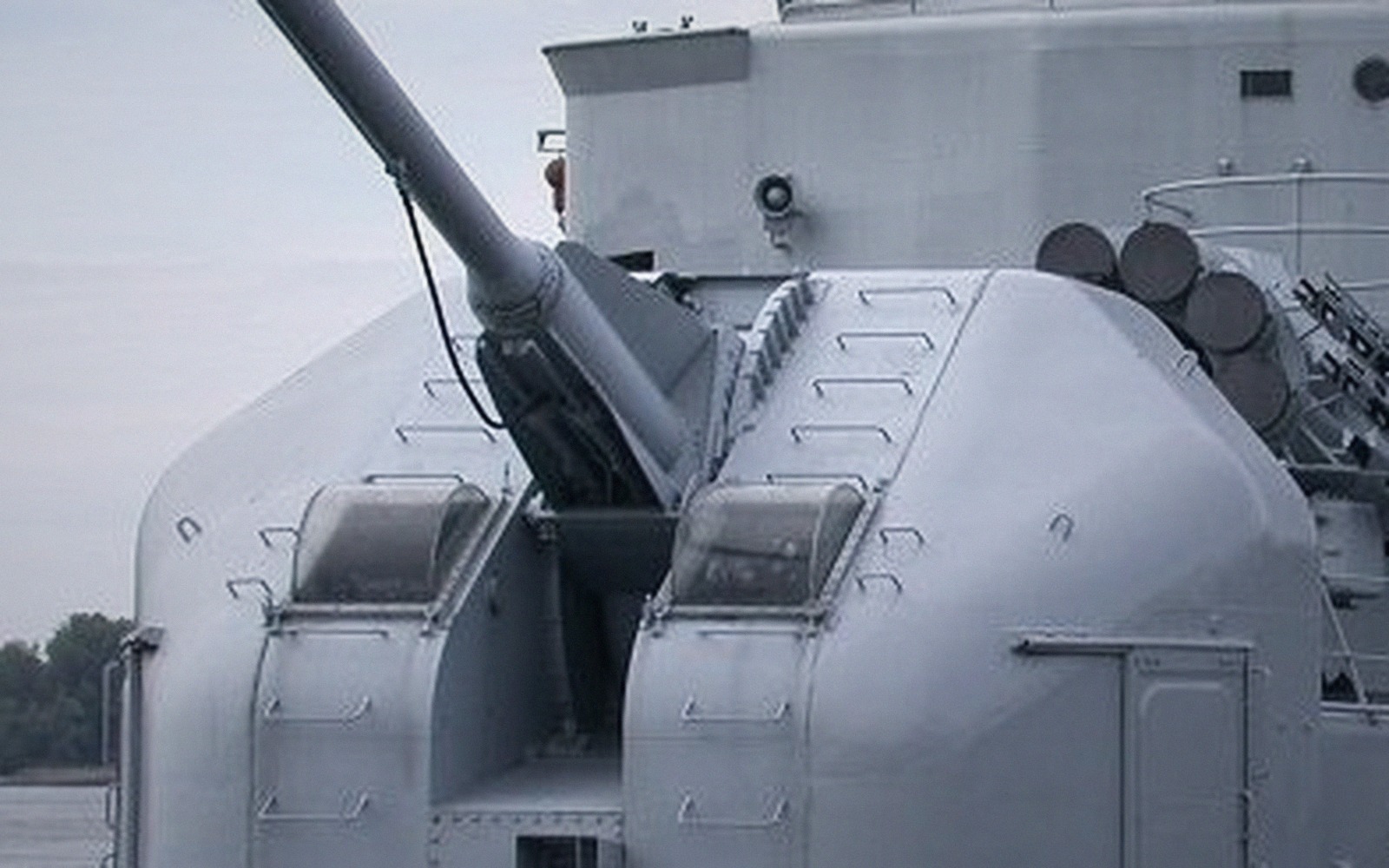
Texas carries ten 14-inch guns arranged in five twin turrets: two forward on the centreline, one amidships, and two aft — a layout that gives her a theoretical ten-gun broadside. The guns themselves are heavy, well-understood engineering: rifled steel tubes weighing around 65 tons each, mounted in hydraulically-powered barbettes, fed by magazine hoists that run deep into the hull. Building them, fitting them, proving them — that was all a solved problem by design. The harder question was what to do once you pointed them at something roughly twelve miles away.
At that range, a shell is in the air for more than thirty seconds. The target is moving. The firing ship is moving. The wind is pushing the projectile sideways. The barrel is warm from a previous round, which changes its muzzle velocity slightly. Atmospheric pressure affects the shell's trajectory. None of these variables is obvious from the bridge, and none of them is static from one salvo to the next.
Key facts · terms used on this page
Plate 03- rangefinder
- optical instrument measuring target distance by angular triangulation across a baseline
- director
- centralised fire-control station that aims and fires guns remotely
- barbette
- armoured cylinder protecting the turret's rotating base and magazine trunk
- muzzle velocity
- speed at which a shell leaves the gun barrel; varies with barrel temperature and propellant
- local control
- fallback mode allowing each turret to aim and fire independently
02The Measurement Chain
When Texas was commissioned in 1914, her primary means of finding range was the optical rangefinder — an instrument that works by measuring the tiny angular difference between the same target seen from two widely separated lenses. The longer the baseline between those lenses, the more precise the reading. Texas shipped rangefinders in her turret roofs and in the conning tower, with the baseline constrained in each case by the geometry of the structure around it. Precision was always a trade-off with physical space.
That range reading then had to be corrected for the firing ship's own speed and heading, for estimated target speed and course, and for all the atmospheric factors already listed. The solution — if "solution" is even the right word for a process still being refined into the late 1910s and through the 1920s — was a director system and the mechanical computing devices that went with it. A director, mounted high in the superstructure where it had the widest view, would observe and measure; the guns in their turrets would be slaved to point where the director commanded rather than where the turret crew could individually see. How rangefinders, directors and the analogue computers behind them actually worked is a subject in its own right, and a deep one.
The barrel is warm from a previous round, which changes its muzzle velocity slightly.
What matters here is that the chain — observation, measurement, calculation, transmission, fire — was only as reliable as its weakest link, and on a steel ship at sea, every link was under stress simultaneously. Electrical runs could be cut. Voice pipes could be jammed. A director crew could be swept away. Texas was built with redundancy in mind: local control from the turrets themselves remained possible, and would be exercised in practice during her long service record.
14-inchcalibre of Texas's main battery guns
5number of twin turrets; 10 guns total
~30 secondsapproximate shell flight time at maximum range
2turrets forward, 1 amidships, 2 aft (centreline arrangement)
03The Ship Moves, Too
The final complication was the firing ship's own motion. A ship rolling even a few degrees is continuously changing the elevation of every gun barrel. Fire on the uproll and the shell goes too far; fire on the downroll and it falls short. Learning to time salvoes to the roll cycle — and eventually building gyroscopic stabilisation into the director — was an iterative engineering process that stretched well into the interwar years, the period when Texas herself was undergoing successive modernisations.
Five turrets are the visible part of the system. The invisible part — the chain of measurement, computation and timing that made them anything other than expensive noise — is where most of the real engineering lived.
Written from published engineering and heritage sources. Where a figure is not documented, this archive describes the engineering rather than asserting a number.
Subjects and places referred to
Texas (BB-35)
Referred to on this page
New York-class battleship, commissioned 1914, subject of this archive