Where USS Texas went, and what she did there — two world wars, three decades of active service, stated as record.
Service History · 03
A Long Service Record, Stated Plainly
Where USS Texas went, and what she did there — two world wars, three decades of active service, stated as record.
Image reference: en.wikipedia.org/wiki/USS_Texas_(BB-35)
01From Commission to the First World War
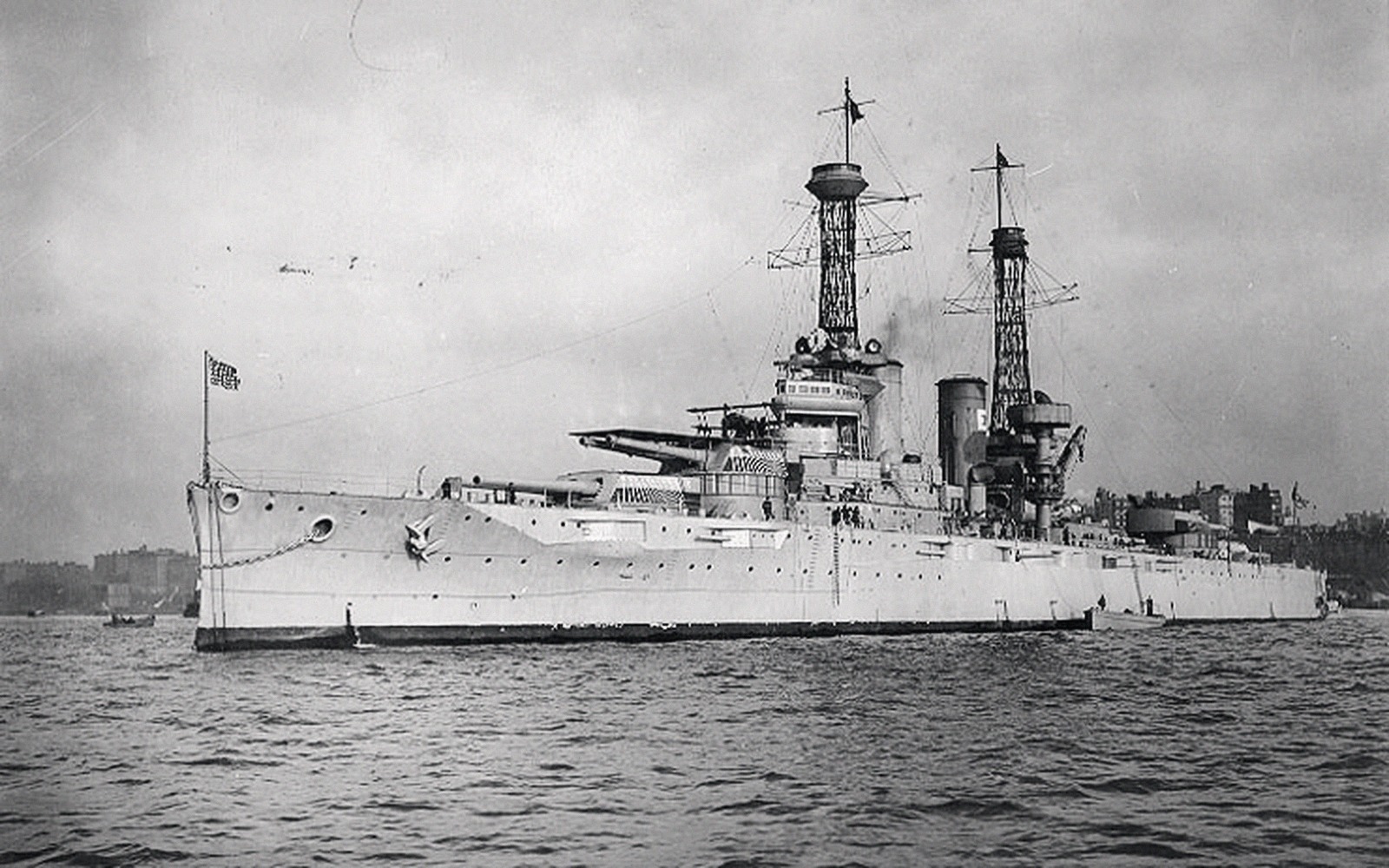
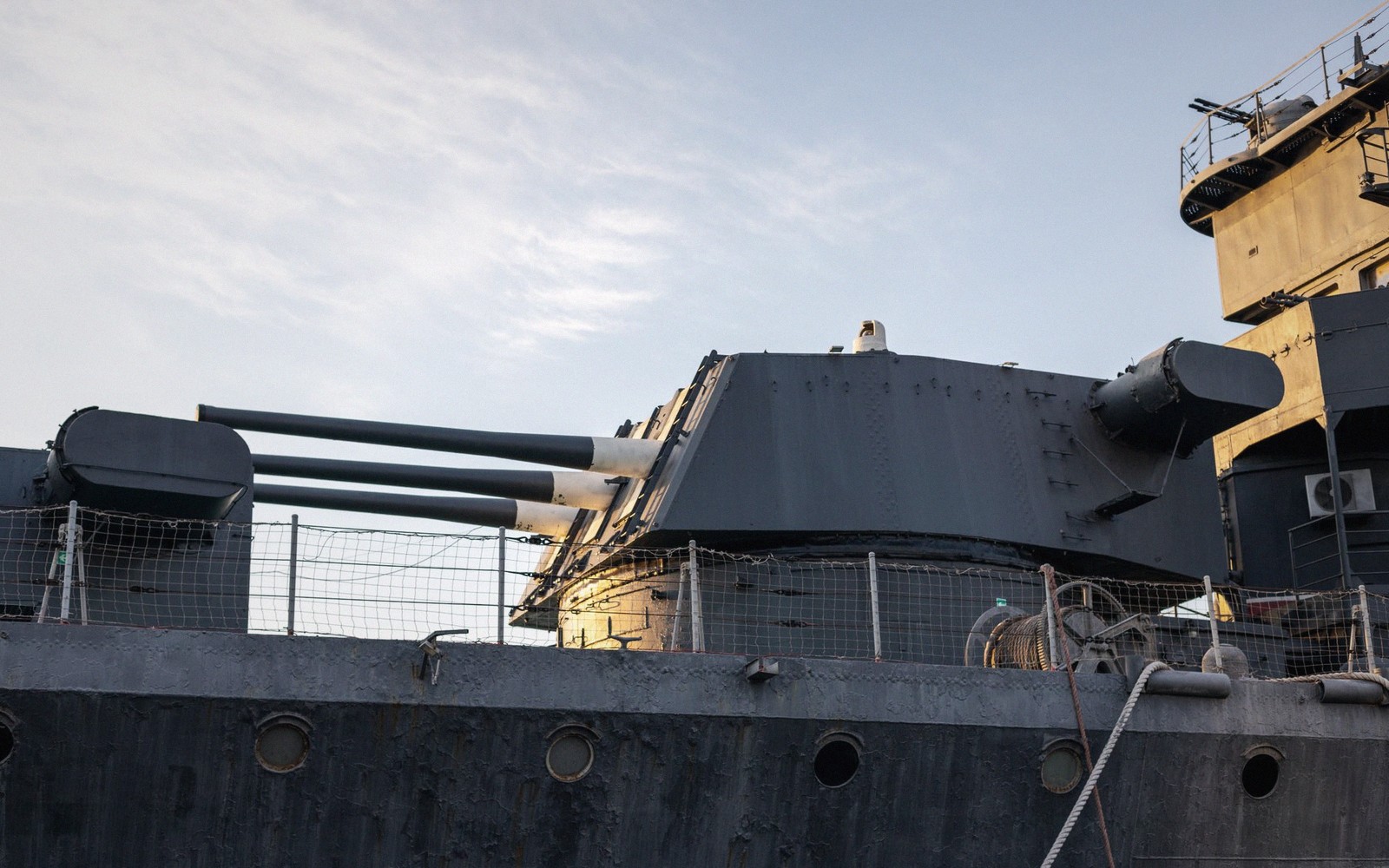
USS Texas was commissioned in March 1914 at the Norfolk Navy Yard, entering service as one of two New York-class battleships — the other being her sister, USS New York. She was a coal-burning, triple-expansion-reciprocating-engined dreadnought carrying ten 14-inch guns in five twin turrets, and she was already, in certain respects, a design behind the moment. The Royal Navy had moved to oil-fired turbine propulsion; the US Navy was catching up. Texas had not yet caught up. What she had was a hull that would prove extraordinarily durable, a service life that would outlast almost every contemporary, and a record that spans the full arc of the battleship's operational era.
Her earliest years were spent working up: shakedown cruises, gunnery exercises, the routine of a new capital ship finding its operational rhythm in the Atlantic. Then the United States entered the First World War in April 1917, and Texas joined Battleship Division Nine — a US Navy formation that operated under British Admiralty command as part of the Grand Fleet, based at Scapa Flow in the Orkney Islands. This was an unusual arrangement, placing American ships under foreign operational control, and it was taken seriously by both sides. The division's primary task was to reinforce the British line against the possibility of a sortie by the Imperial German High Seas Fleet — a sortie that, in the event, never came. Texas spent much of the war at anchor or on patrol in cold northern waters, contributing to a deterrent posture rather than to combat. The High Seas Fleet was bottled up; the Grand Fleet's presence was the reason it stayed that way.
The armistice in November 1918 changed her immediate task. Texas was among the Allied warships that escorted the surrendered German fleet to internment at Scapa Flow in late 1918, standing witness to one of the more remarkable spectacles in naval history: the largest fleet in the world delivering itself into captivity without a fight. She then returned to American waters and to the interval of peace.
02Between the Wars: Modernisation and Change
The interwar period reshaped Texas substantially. In the 1920s she underwent significant modernisation work — cage masts were replaced by tripod masts, anti-aircraft armament was added and reconfigured across several refits, and fire-control systems were progressively updated. She also converted from coal to oil fuel during this period, a change that transformed her endurance, reduced her crew demands in the engineering spaces, and ended the brutal labour of the coalhole. The ship that emerged from interwar refit cycles was recognisably Texas, but upgraded at nearly every level of her fighting and navigational systems.
She also received her distinctive anti-torpedo blisters — external sponsons added to both sides of the hull below the waterline — which increased her beam significantly and altered her silhouette in photographs taken from that era onward. The blisters added buoyancy and offered some protection against underwater explosions, but they also reduced her speed somewhat and changed the geometry of the hull that maintainers would be managing for the rest of her life.
This was an unusual arrangement, placing American ships under foreign operational control, and it was taken seriously by both sides.
In the 1930s Texas served in fleet exercises, appeared at reviews, and functioned as a training vessel and fleet workhorse in the way that ageing capital ships tend to do — useful, not obsolete, but no longer at the cutting edge. By the time the second world war arrived, she was a pre-war battleship in a conflict that was already moving toward the carrier and the submarine as its decisive instruments. Her role would be shaped accordingly.
14-inchmain battery gun calibre
5number of twin turrets
34 yearsactive service span (1914–1948)
1922 (approx)period of coal-to-oil fuel conversion
03The Second World War: Shore Bombardment and Support
Texas entered the Second World War in a role suited to a heavily armoured, slow, large-calibre-gun platform that could not keep up with a fast-carrier task force: she became a naval fire support ship, putting 14-inch shells ashore in advance of amphibious landings. This was not a secondary role. Amphibious operations were among the most complex and costly undertakings of the war, and the suppression of coastal defences and enemy positions in the hours before troops hit the beach was operationally critical.
She was present at the Allied landings in Northwest Africa in November 1942 — Operation Torch — supporting the assault on the Moroccan coast. In June 1944 she stood off the coast of Normandy for the D-Day landings, providing naval gunfire support to Allied forces going ashore on Omaha Beach. She was assigned to support the western end of that sector, directing fire against German positions in conditions of heavy resistance. Her 14-inch guns, firing at ranges where the gun crews could not see their targets and depended on spotters and fire-control coordination, engaged shore fortifications and artillery positions. In August 1944 she was part of the bombardment force supporting the landings in southern France — Operation Dragoon — again in a naval fire support role.
Her Pacific service followed. Texas operated in support of the landings at Iwo Jima in February 1945, contributing pre-invasion bombardment, and at Okinawa in April 1945 in the same capacity. These were the largest amphibious operations in the Pacific theatre, mounted against heavily fortified positions, and the sustained fire support provided by battleships like Texas across the preparatory phases was a standard element of operational planning by that point in the war.
She was decommissioned in April 1948, having served the United States Navy in an active capacity for thirty-four years. No other American battleship that served in both world wars has survived into preservation. That fact alone gives her record a particular character — not simply as a long service history, but as the only remaining physical evidence of a class of warship, and a type of naval service, that has otherwise passed entirely out of existence.
Chronology · stated as record
- 1914Commissioned at Norfolk Navy Yard
- 1917–1918Served with Grand Fleet at Scapa Flow under British Admiralty command
- 1918Escorted surrendered German fleet to internment
- 1920s–1930sInterwar modernisation: tripod masts, anti-aircraft upgrades, blister addition, fuel conversion
- 1942Operation Torch, Moroccan landings
- 1944 (June)D-Day, Normandy fire support
- 1944 (August)Operation Dragoon, southern France
- 1945Iwo Jima and Okinawa fire support
- 1948Decommissioned; transferred to State of Texas
- 2022Towed to Galveston for dry-dock hull restoration
04Preservation
Texas was transferred to the State of Texas in 1948 and berthed at the San Jacinto Battleground State Historic Site near Houston, where she served as a memorial and museum ship for decades. The years were not kind to the hull. A steel ship in brackish water, with limited maintenance budgets and the slow accumulation of corrosion damage across riveted seams and plate faces, deteriorates in ways that are initially invisible and eventually catastrophic. By the early twenty-first century, the condition of her hull had become a serious engineering problem requiring intervention at a scale the ship had not seen since her wartime refits.
She was towed — without power, on her own aged hull — to a dry dock in Galveston, Texas, for a major restoration programme beginning in 2022. The dry-docking allowed access to her underwater hull for the first time in many decades, enabling inspection, plate renewal, and structural work that could not be done afloat. The programme represents the most significant investment in her physical survival since commissioning, and its outcome will determine whether the ship that has kept herself afloat this long continues to do so for another generation.
Written from published engineering and heritage sources. Where a figure is not documented, this archive describes the engineering rather than asserting a number.
Subjects and places referred to
Scapa Flow
Referred to on this page
British Grand Fleet anchorage, Orkney Islands, Scotland
Norfolk Navy Yard
Referred to on this page
commissioning site
San Jacinto Battleground State Historic Site
Referred to on this page
long-term preservation berth near Houston
Galveston, Texas
Referred to on this page
location of dry dock used for 2022 restoration