She was state-of-the-art the day she was laid down, and already being outpaced the day she was commissioned.
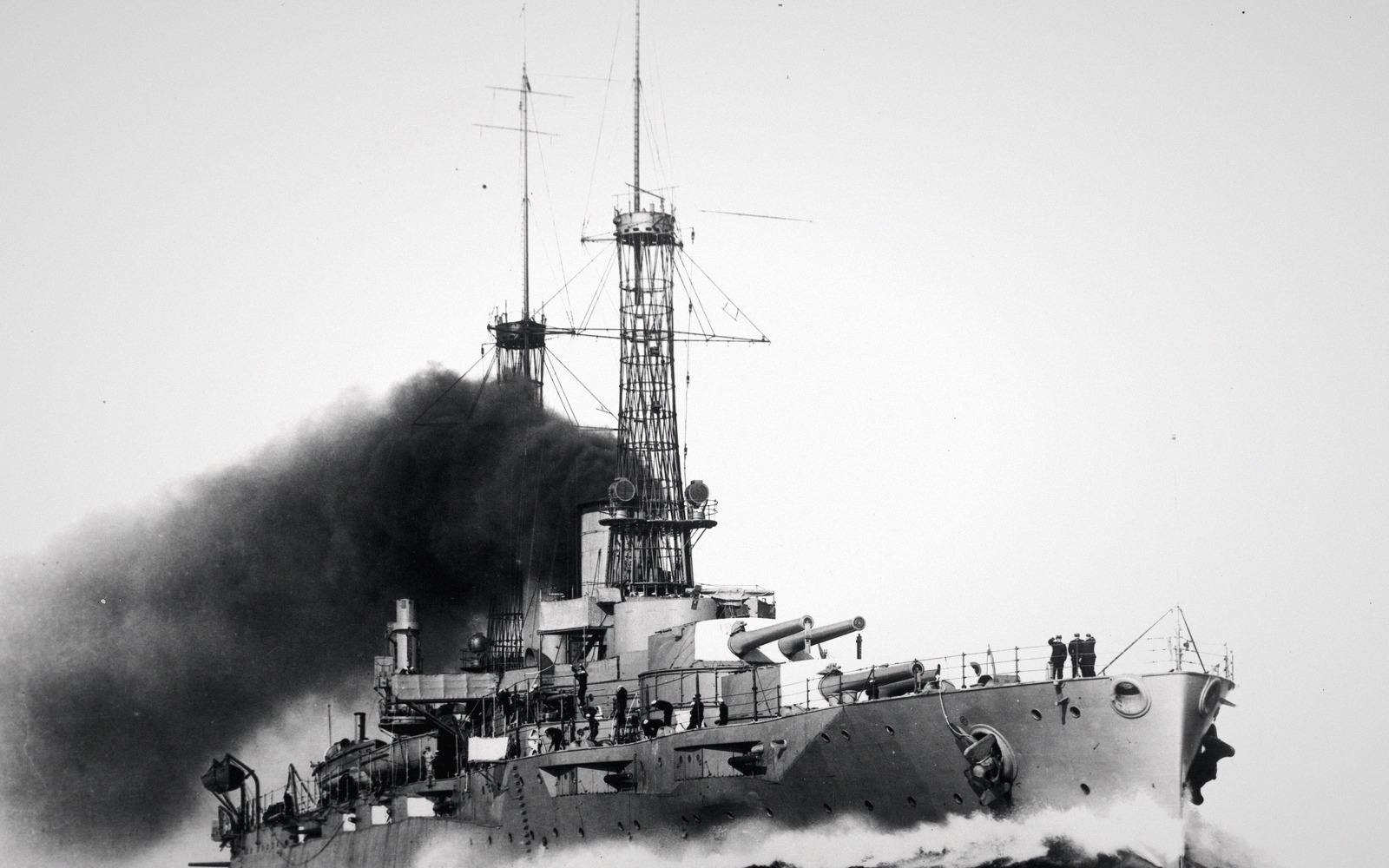
Service History · 03
Commissioned 1914
She was state-of-the-art the day she was laid down, and already being outpaced the day she was commissioned.
Image reference: en.wikipedia.org/wiki/New_York-class_battleship
01A Class Behind the Curve
USS Texas was commissioned on 12 March 1914, completing a construction programme that had begun in 1911. She was a New York-class dreadnought: ten 14-inch guns arranged in five twin turrets, driven by triple-expansion reciprocating engines at a time when turbine propulsion was becoming the standard for capital ships. She was powerful, well-armoured, and almost immediately superseded.
The problem was not her guns. Fourteen inches was a serious calibre, and the five-turret arrangement gave her a respectable broadside. The problem was pace — technological pace, specifically. By 1914, the Royal Navy was already operating turbine-driven dreadnoughts that were faster and more fuel-efficient than anything running reciprocating machinery. The Nevada class, authorised in 1911, the year Texas was laid down, introduced all-or-nothing armour and oil-fired boilers as American standards. Texas, still burning coal, was already a generation behind before she cleared her first shakedown.
This is not a criticism. The Navy ordered her from within the knowledge available in 1911, and what they received was a sound, well-built ship. Riveted construction, heavy plate, a hull that would prove durable well beyond anyone's expectations. What the commissioning date marks, rather, is how rapidly the dreadnought type was evolving during precisely these years — a pace so fierce that even a brand-new vessel could arrive at her commissioning ceremony already belonging to the previous chapter.
The Nevada class, authorised in 1911, the year Texas was laid down, introduced all-or-nothing armour and oil-fired boilers as American standards.
Written from published engineering and heritage sources. Where a figure is not documented, this archive describes the engineering rather than asserting a number.
Key facts · terms used on this page
Plate 03- dreadnought
- class of battleship defined by uniform heavy armament and high speed
- triple-expansion
- reciprocating steam engine expanding steam through three cylinders in sequence
- all-or-nothing armour
- scheme concentrating armour on vital areas, abandoning light protection elsewhere
- broadside
- total weight or number of guns that can bear on one side simultaneously

12 March 1914commissioning date of USS Texas
14-inchcalibre of Texas's main battery guns
5number of twin turrets carrying the main battery
1911year her keel was laid
Chronology · stated as record
- 1911keel laid, construction begins
- 1914commissioned
- 1914 onwardturbine propulsion becomes capital-ship standard
Subjects and places referred to
New York class
Referred to on this page
two-ship US Navy battleship class; Texas and her sister USS New York
Nevada class
Referred to on this page
successor US battleship class introducing oil firing and all-or-nothing armour