Shell plating, blister, void, armour belt, machinery space — five layers, five jobs.
The Ship · 01
Reading Her From the Water Inwards
Shell plating, blister, void, armour belt, machinery space — five layers, five jobs.
01Five layers, five different jobs: how Texas is built from the outside in
At any given moment, the steel between USS Texas and the Gulf of Mexico is not a wall but a system — a sequence of layers, each doing a different job, each depending on the ones beside it. From the surface of the water inwards, there are five of them: shell plating, blister, void, armour belt, and the machinery spaces at the core. Understanding what each layer does, and why it sits where it sits, is one of the better ways to understand how a dreadnought actually works as an engineering proposition.
Key facts · terms used on this page
Plate 03- shell plating
- the outer skin of a hull; a structural and watertight surface
- strake
- a continuous row of hull plates running along the ship's length
- blister
- a bulged sponson structure added to a hull's sides for protection and stability
- void compartment
- an empty or controllable-flooding space used in torpedo protection
- armour belt
- a continuous waterline strake of face-hardened plate protecting vital spaces
- face-hardened plate
- armour with a hard surface layer bonded to a tough backing
02The first layer: shell plating
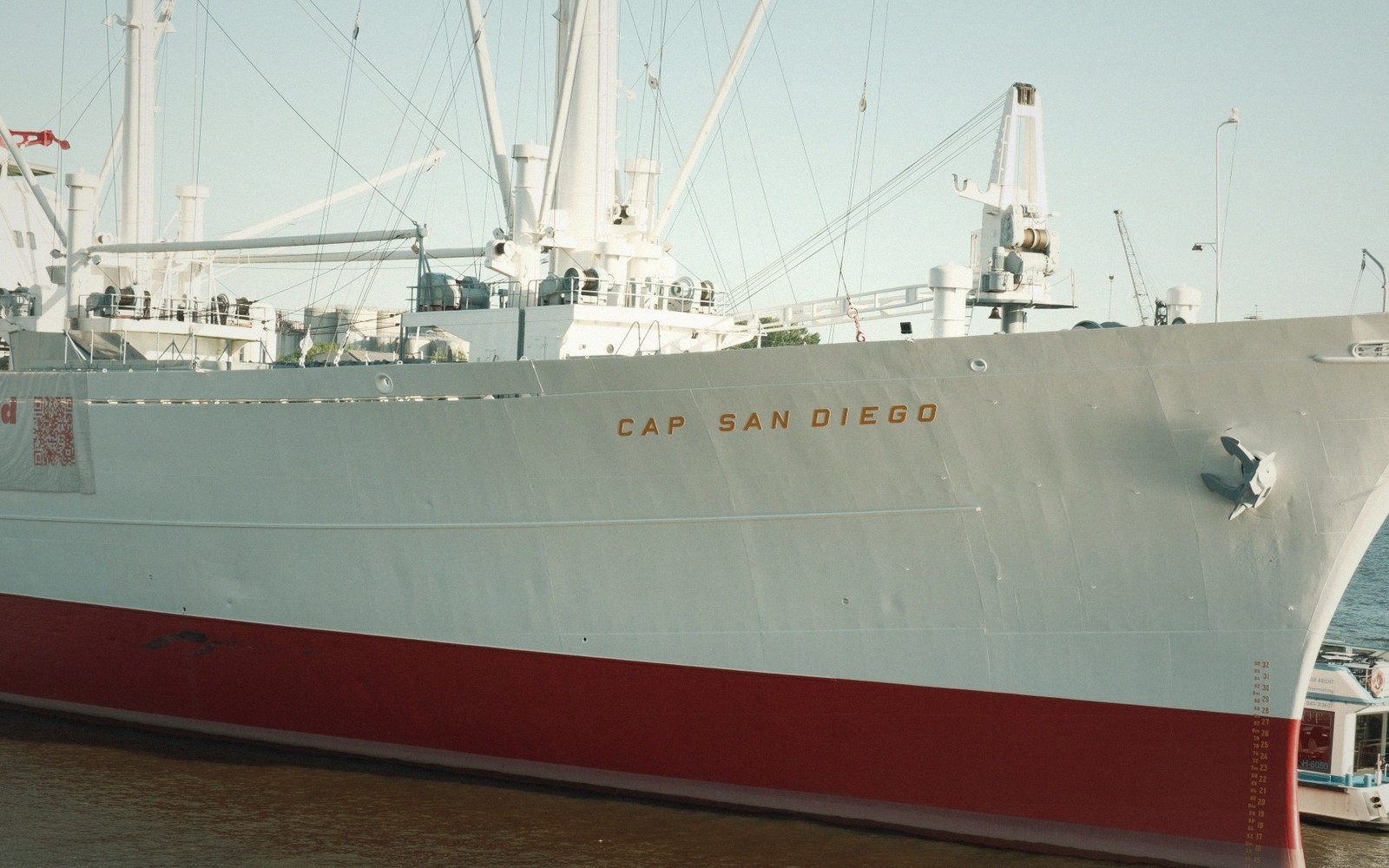
The outermost skin is shell plating — the hull itself, the surface you see when you look at the ship from the dock. On Texas, this is a riveted construction: overlapping strakes of steel plate, each plate punched with rows of holes, the whole thing held together by hundreds of thousands of driven rivets whose upset heads create a friction joint so tight it becomes, in effect, a single surface. The plating varies in thickness depending on where it sits on the hull: thicker at the turn of the bilge, where the vessel's own weight concentrates stress; thinner higher up on the topsides, where the loading is lighter.
Shell plating does two things. The obvious one is watertightness — it keeps the sea out. The less obvious one is structural: these plates carry tensile and compressive loads along the length of the hull as the ship works in a seaway, bending slightly over wave crests and between them in a cycle that never entirely stops. The riveted seams are not just fasteners; they are part of how bending stresses are distributed and transferred between plates. A fracture in one plate, or a run of failed rivets, changes the load path for everything adjacent to it. The plating is not passive skin; it is an active structural member.
A fracture in one plate, or a run of failed rivets, changes the load path for everything adjacent to it.
Because it is also the surface in direct contact with seawater, shell plating is where corrosion begins. The electrochemical process — saltwater as electrolyte, dissimilar metals or weld heat-affected zones as the differential — attacks from outside, and from inside wherever condensation or bilge water reaches the back face. On a ship over a century old, the thinning that results from that continuous attack is not cosmetic. Below a certain thickness, plate stops being able to carry its share of the structural load, which is why knowing the actual remaining thickness in each strake matters more than how the hull looks from the pier.
fivethe distinct functional layers from hull exterior to machinery core
twoproblems the blisters solved simultaneously (torpedo protection and stability)
03The second and third layers: blister and void
Move inward from the shell plating and, along a significant portion of Texas's mid-hull length, you encounter the blisters — large bulged sponson-like structures added to the ship's sides well after her original construction. These are not part of the original design; they were retrofitted to answer two problems at once. The first was underwater protection: by the time they were added, the threat from torpedoes and mines was real and understood, and a blister provides a standoff layer that causes a weapon to detonate before it reaches the main hull. The second was stability: the additional beam the blisters created lowered the ship's centre of gravity relative to her metacentre, improving the roll characteristics that had been compromised by the weight of modifications added high in the structure over the years.
A blister is not a solid mass of steel. It is a hollow structure — which brings us to the third layer: void. The interior of a blister is divided into compartments, some of which can be left empty and some of which can be flooded with water as ballast to fine-tune trim and list. The void compartment serves a specific physics purpose in torpedo protection: when a warhead detonates in or against the outer skin of the blister, the explosive energy expands outward into open space before it can be transmitted as a pressure pulse to the main hull. Air and water behave very differently under sudden compression, and the void exploits that difference. The energy is dissipated, scattered and attenuated before it crosses the void and meets the structural steel beyond.
Maintaining the blisters in a preservation context introduces its own complications. The original shell plating of the main hull exists behind the blisters where they attach, in conditions of very limited accessibility and very high moisture retention — exactly the combination that accelerates corrosion most aggressively. When steel behind a blister section deteriorates past the point of serviceable thickness, reaching it requires removing or opening the structure that was added to protect it.
Chronology · stated as record
- original commissioning, 1914ship enters service with shell plating and armour belt as built
- blister addition, 1920sblisters retrofitted, adding the second and third layers to the existing hull
04The fourth layer: the armour belt
Beyond the void — inboard of the blister's inner face, running as a continuous strake along the waterline — sits the armour belt. This is steel of a fundamentally different character from shell plating: it is face-hardened plate, manufactured by a process that produces a harder crystalline surface layer bonded to a tougher backing, the combination designed to shatter an incoming projectile at the face while absorbing residual energy in the backing without cracking through entirely.
The armour belt on Texas covers the waterline zone protecting the boiler rooms, engine rooms and magazine spaces — the vital machinery and the powder that feeds the guns. Its vertical extent is calculated to keep it effective across the range of draughts the ship might operate at, fully loaded or light. The thickness is not uniform across its full height: it tapers toward the top and bottom edges, because the probability of a projectile arriving on a flat trajectory and striking near the waterline at exactly that elevation governed the distribution of weight.
Armour is dense and it is heavy, and its weight contribution to the hull's girder is not negligible. But unlike shell plating, the armour belt contributes little to the primary longitudinal structural strength of the ship — it is not designed to carry bending loads; it is designed to resist ballistic impact. The two functions are served by different material properties, and a naval architect has to account for both simultaneously, which is part of why battleship design at this period was as much a weight-management exercise as anything else.
In a preservation context, the armour belt presents a different problem set from the shell plating. Because it is thick and dense, it corrodes more slowly through its section; because it sits inboard of the blister and void, behind the outer layers, in a less aggressively wet zone, it survives comparatively well. But the attachments and transitions between the armour strake and the structural framing are complex joints with multiple material interfaces — exactly the geometry where crevice corrosion concentrates.
05The fifth layer: the machinery spaces
At the core of the ship, behind all of the above, sit the spaces that make her function — or rather, that once made her function and now constitute the principal heritage engineering exhibit she contains. The boiler rooms and engine rooms are arranged longitudinally and transversely in a sequence that reflects the priority of each space and its vulnerability to flooding damage: if one compartment is breached, the watertight subdivision limits flooding to that compartment and the ship remains buoyant and mobile.
Texas's triple-expansion reciprocating engines — the machinery that drove her throughout her working life — occupy a protected core position specifically because they are irreplaceable in action. The armour belt, the void, the blister, and the shell plating together form a layered envelope whose whole purpose is to ensure that a weapon must defeat multiple independent systems before it can reach this interior. The logic is cumulative: each layer is not expected to stop everything alone, but together the succession of them degrades and attenuates any threat so that what arrives at the innermost spaces is reduced in energy below the threshold of catastrophic damage.
Written from published engineering and heritage sources. Where a figure is not documented, this archive describes the engineering rather than asserting a number.
Subjects and places referred to
USS Texas (BB-35)
Referred to on this page
New York-class dreadnought battleship, now preserved in Texas
Gulf of Mexico
Referred to on this page
the operational and preservation environment for the hull