Reciprocating machinery on a capital ship, and why she kept it.
Machinery & Armament · 02
Triple-Expansion, in an Age of Turbines
Reciprocating machinery on a capital ship, and why she kept it.
01The steam engine that refused to be obsolete — why USS Texas was built with reciprocating machinery when turbines were already winning the argument
Key facts · terms used on this page
Plate 03- triple-expansion engine
- steam engine expanding through three cylinders at decreasing pressure
- crankshaft
- rotating shaft converting reciprocating piston motion to rotation
- direct-drive turbine
- turbine rotor connected directly to propeller shaft without gearing
- reduction gearing
- gear set reducing turbine shaft speed to usable propeller speed
- valve gear
- mechanism controlling steam admission and exhaust timing in a cylinder
- crosshead
- sliding joint linking piston rod to connecting rod in a reciprocating engine
02A Decision Already Being Questioned
By the time USS Texas was laid down in 1911, the marine steam turbine had already proved itself on capital ships. HMS Dreadnought herself, launched in 1906, had turbines. The Royal Navy's experience with turbines in destroyers and then in battleships had been broadly positive: quieter running, far fewer moving parts, and at high speeds a clear advantage in efficiency. The United States Navy was watching closely. And yet Texas — authorised under the same congressional act as her sister New York — was given reciprocating machinery: two triple-expansion steam engines, each driving its own shaft.
This was not ignorance, and it was not inertia. It was a calculated engineering choice made under real uncertainty, and understanding why requires taking the turbine's weaknesses as seriously as its strengths.
Steam enters a small, high-pressure cylinder first, does work by expanding against a piston, and exhausts into a medium-pressure cylinder.
4number of shafts and triple-expansion engines aboard Texas
~21 knotsdesigned top speed
1906launch year of HMS Dreadnought, first turbine-powered capital ship
1911year Texas was laid down
03What Triple-Expansion Actually Means
A triple-expansion reciprocating engine does something intuitive once you see it: it extracts energy from steam in three successive stages, each at a lower pressure than the last. Steam enters a small, high-pressure cylinder first, does work by expanding against a piston, and exhausts into a medium-pressure cylinder. That exhaust — still carrying usable energy — expands again, then exits into a large, low-pressure cylinder for a final working stroke. The cylinders differ in diameter because the same mass of steam, expanding progressively, occupies more and more volume at each stage. The low-pressure cylinder on a large marine installation is enormous by comparison with the high-pressure one beside it.
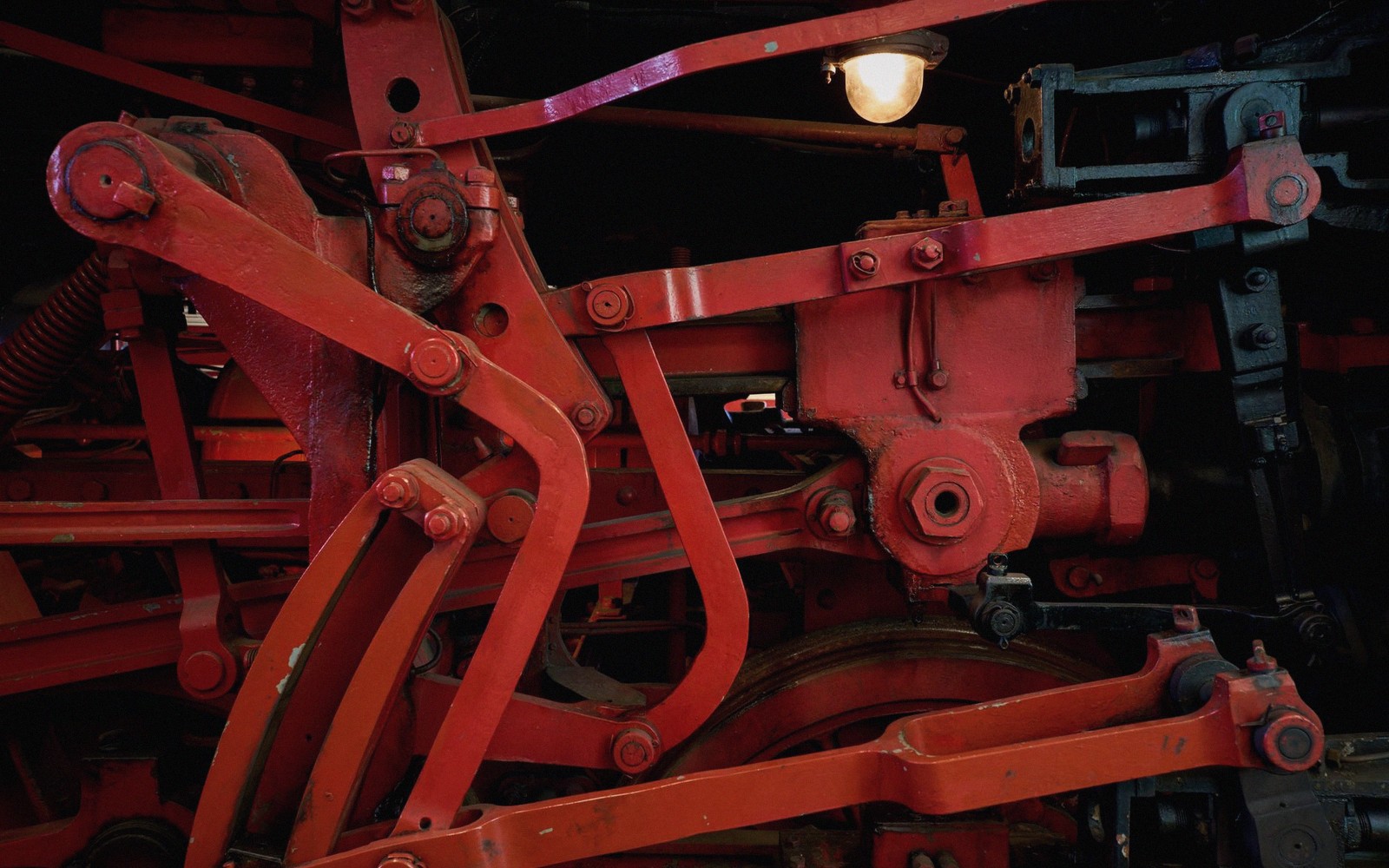
Each cylinder drives a connecting rod to a crank on a crankshaft, and the crankshaft turns a propeller shaft. It is direct mechanical translation of steam energy into rotation, through levers and pins and crossheads, in a way that a watchmaker's apprentice would recognise as machinery. The forces involved are vast — Texas's engines drove propellers on two shafts — but the mechanical principle is continuous with James Watt.
The virtues are real. A reciprocating engine is efficient across a wide range of speeds. It reverses: engage the valve gear in reverse and the engine drives the shaft backwards, immediately useful for docking and manoeuvring. It can be throttled finely, it can be started cold without elaborate preparation, and when something goes wrong a trained engineer can see what has gone wrong. The fault is mechanical and physical: a worn bearing, a leaking piston ring, a sticking valve. These are repairable.
Chronology · stated as record
- 1906HMS Dreadnought launched with turbine propulsion
- 1911Texas laid down with triple-expansion reciprocating engines
- 1914Texas commissioned
- Post-WWITexas converted from coal to oil firing
04What the Turbine Could Not Do
The marine turbine's weakness in 1911 was not in speed. At high revolutions it was clearly superior. The problem was everything else. Turbines of the period were enormously inefficient at cruising speeds, which is where a battleship spent most of its life. A capital ship sprinting to action at full power was a fraction of its career; the rest was steaming at moderate speed across large bodies of water, and at those speeds the early direct-drive turbine was burning fuel at a rate that cut range severely.
The second problem was reversing. A turbine rotor spins one way. You cannot reverse a turbine by reversing its steam supply. The solution was a separate astern turbine — additional weight, additional cost, additional machinery — or later the development of reduction gearing and electric drive, neither of which was mature when Texas was designed. A ship that could not back down reliably in harbour was a liability, and the US Navy was not yet satisfied that turbine installations had solved this cleanly.
Third: repair at sea. If a reciprocating engine's piston rings fail, a skilled engineering officer with a machined spare can effect a repair. If a turbine blade fractures — and early turbine blades did fracture, especially under thermal shock — the damage is catastrophic and irreparable without a dockyard. For a navy whose operating radius included the Pacific, that repairability argument carried weight.
05Why Texas Got Reciprocating Engines
The Bureau of Steam Engineering's conclusion for Texas and her New York class was essentially conservative in the best engineering sense: accept a known technology's limitations rather than accept unknown risks from a newer one. Turbines were winning the argument in Britain. They were not yet winning it entirely in Washington.
There was also a specific operational concern about fuel consumption at cruising speed. The US Navy in 1911 was calculating ranges and coal capacities for a two-ocean strategic situation. Texas was converted from coal to oil firing some years after commissioning, but at the time of design, range was calculated on coal, and coal-fired triple-expansion engines at moderate speed were understood quantities.
The decision produced an installation of two shafts, two engine rooms, and boilers whose steam pressure and temperature were closely matched to what triple-expansion required. The machinery was designed as a system, not as a collection of components. That matters, because changes to one element — higher steam pressure for greater efficiency, say — would have rippled through everything.
06Living With the Choice
What did it mean in practice? Texas was slower than contemporary British dreadnoughts equipped with turbines, and she was always going to be. Her designed speed was around 21 knots, achievable on trials; in service, with a hull accumulating fouling and years, somewhat less. Against turbine-driven ships she could not match top speed, and by the time of her service in the First World War, that was a known characteristic rather than a surprise.
What she had was mechanical dependability of a kind that engineering officers understood and could maintain. Her engine rooms — and they are rooms, not caverns; the machinery does not dwarf a person the way a turbine plant does — were legible spaces. The reciprocating engine's motion is visible: you can watch the crossheads travel, observe the valve gear cycling, hear the rhythm of working pistons. Faults announced themselves audibly before they became failures. There is an argument, not entirely romantic, that crew could form a working relationship with this machinery that they could not form with a turbine.
The engines also delivered something turbines of the era genuinely struggled with: precise slow-speed manoeuvring. A reciprocating engine can idle in gear, can be given brief impulses ahead or astern, can be worked against itself in the way a ship handler needs when pressing a hull against a dock. This is not a trivial advantage. Capital ships are large and harbour margins are small.
07What Survives
Texas was preserved with her reciprocating machinery in place, and those engines — now static — remain aboard her. After more than a century, the physical bulk of the installation makes the engineering logic of the era tangible. The cylinder sizes express the thermodynamic logic of three-stage expansion visually: a visitor can stand beside the low-pressure cylinder and understand, without being told, that something large and slow was happening here.
The choice of triple-expansion in 1911 was not backwardness. It was a professional judgement made at a moment when turbine technology was improving rapidly but had not yet answered the questions that mattered most to the engineers who had to take a hull to sea and bring it back. Within a decade those questions had answers — reduction gearing matured, cruising turbines improved, the reversing problem was better managed — and the reciprocating capital ship became genuinely obsolete. But Texas was built at the inflection point, not after it, and her machinery reflects the considered opinion of engineers who were not wrong to be cautious.
Written from published engineering and heritage sources. Where a figure is not documented, this archive describes the engineering rather than asserting a number.
Subjects and places referred to
Bureau of Steam Engineering
Referred to on this page
US Navy bureau responsible for propulsion plant design and specification
HMS Dreadnought
Referred to on this page
Royal Navy battleship whose turbine installation set the capital-ship standard
Texas
Referred to on this page
state whose name the battleship carries; also her eventual preservation location