A second skin added decades after launch — and what it did to her beam, her stability, and the way she sits in the water today.
The Ship · 01
The Blisters Changed Her Shape
A second skin added decades after launch — and what it did to her beam, her stability, and the way she sits in the water today.
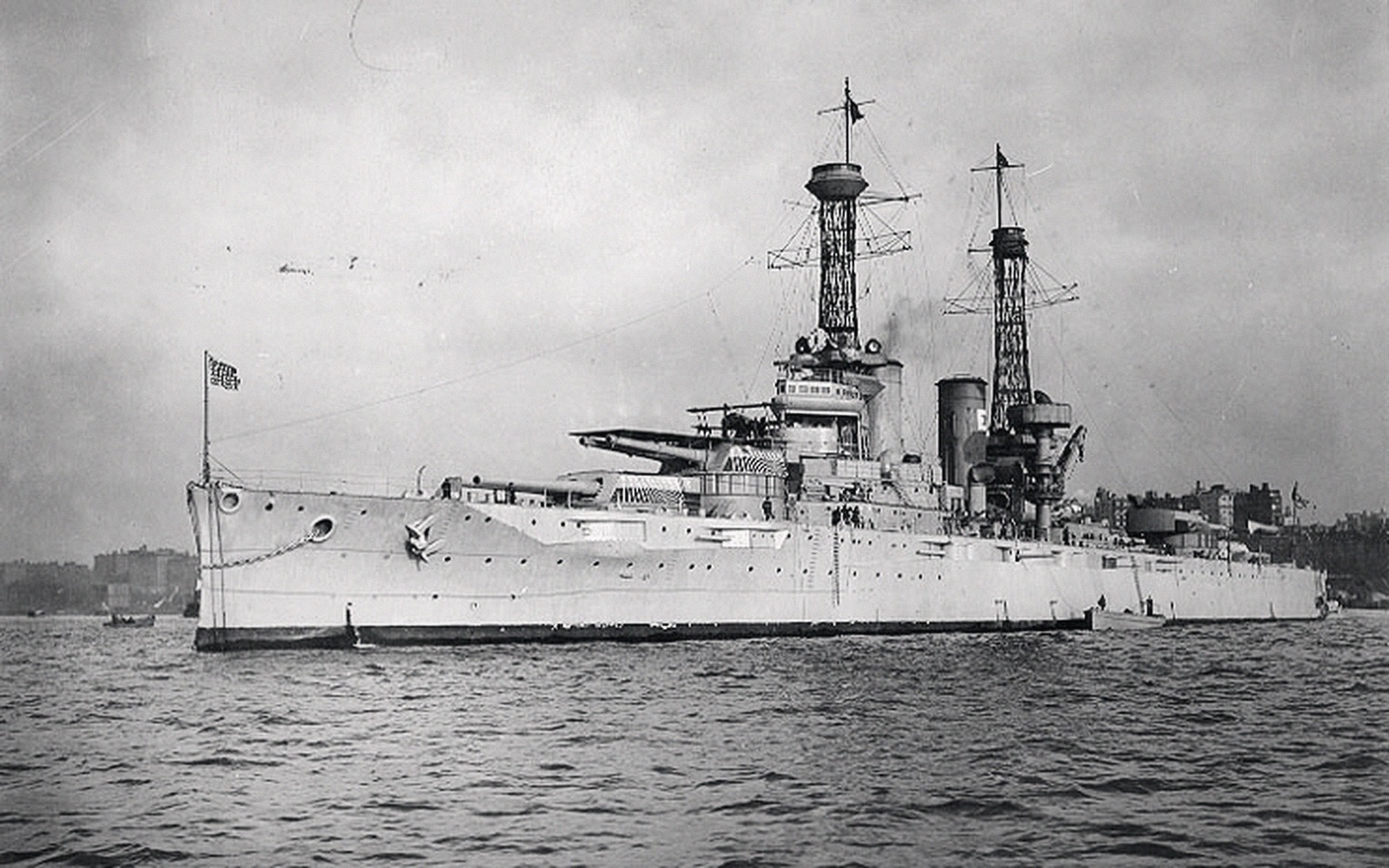
Image reference: en.wikipedia.org/wiki/USS_Texas_(BB-35)
01The hull she was born with
When USS Texas was commissioned in 1914, her beam measured around 95 feet. That is the hull as designed: a New York-class dreadnought drawn up in the pre-war years, before the lessons of Jutland, before torpedo development sprinted forward, and before naval architects began losing sleep over the vulnerability of a warship's underwater body to a single well-placed hit. The original hull was a lean, purposeful shape. Everything about it said speed — or at least, the best speed her triple-expansion reciprocating machinery could manage.
That shape did not survive the interwar period intact. In the mid-1920s, Texas went into the yard and came out a measurably wider ship. Not because her frames had been spread, and not because the original hull had been replated — but because an entirely new structure had been bolted to her sides below the waterline. These were the anti-torpedo blisters, and they changed almost everything a naval architect cares about.
Key facts · terms used on this page
Plate 03- blister
- watertight external compartment fastened to hull sides for torpedo protection
- metacentric height
- geometric measure of a vessel's initial stability; higher means stiffer roll
- beam
- the maximum width of a hull, measured at the widest point
- wetted surface area
- hull area in contact with water; more area increases drag
- waterplane area
- cross-sectional area of the hull at the waterline
02What a blister actually is
A blister is a watertight external compartment, typically lens-shaped in cross-section, fastened along the outside of the existing hull below the main deck. The term is descriptive: the structure bulges outward from the original plating the way a blister rises from skin. On Texas, the blisters ran along the length of the machinery and magazine spaces — the sections where a torpedo strike would be most catastrophic.
The protective logic was layered. A torpedo detonating against the outer face of a blister expends much of its energy in the void or liquid-filled compartment before it ever reaches the original shell plating. Some blisters were filled with water or oil; others were left as empty void spaces; some combined both arrangements in sequence. The outermost skin takes the initial shock. The inner structure absorbs and distributes what remains. Done well, it means the ship's vital spaces have a fighting chance of staying dry.
In the mid-1920s, Texas went into the yard and came out a measurably wider ship.
There was a second benefit, understood from the outset but never the headline argument: buoyancy. Adding sealed volume to the sides of the hull increases displacement and raises the hull in the water — or, depending on how you account for it, allows more weight to be added elsewhere while keeping the same draft. For a ship accumulating the extra topside weight that modernisation always brings — heavier directors, added anti-aircraft platforms, more communications equipment — that reserve buoyancy was not a luxury. The modernisation programme added considerable weight above the waterline over the years; the blisters gave the hull somewhere to put it.
~95 feetoriginal beam of Texas at commissioning
~10 feetapproximate beam increase added by anti-torpedo blisters
1914year of commissioning, before blisters were fitted
03What they cost her
The arithmetic of blisters is unforgiving. You gain protection and buoyancy; you pay for them in beam and resistance. Texas's beam grew by something in the region of ten feet when the blisters were fitted — a transformation that is easy to state and easy to underestimate. Ten feet of additional width does not simply mean a wider shadow on the water. It means a different ship in almost every hydrodynamic sense.
The wider waterplane area changed her metacentric height — the geometric measure of initial stability — and altered the period of her roll. A ship with greater metacentric height tends toward a snappier, shorter roll: she rights herself more aggressively, which is harder on structure and harder on the crew. Blisters typically push metacentric height upward, and Texas after modification was a demonstrably stiffer ship than she had been before. Stable, yes. Comfortable to live aboard, rather less so in any kind of sea.
Speed suffered too. The blisters added wetted surface area and disrupted the clean underwater lines the original designers had drawn. A hull form optimised for a certain beam cannot simply have ten feet of structure fastened to its sides without penalty. The precise reduction in top speed is difficult to state cleanly, because Texas's machinery also aged across the same period, but the direction of the effect is not in doubt. She was never going to be fast. After the blisters, she was slower still.
Chronology · stated as record
- 1914commissioned with original lean hull form
- 1925–27anti-torpedo blisters fitted during refit, beam increased significantly
04The shape she carries now
What makes the blisters historically interesting is that they did not come off. They were fitted as part of an interwar modernisation, proved their worth as a stability and protection solution across a long service career, and became part of the ship so completely that separating the blister from the hull is now a philosophical as much as an engineering question. The structure that visitors see when Texas sits in the water — that wide, low, slightly ungainly profile — is the blister profile, not the 1914 profile. The original lean hull still exists inside it, but you cannot see it from the shore.
For the engineering teams working on her preservation and hull restoration, the blisters are not an addition to be undone. They are load-bearing elements of the structure as it exists. The layered cross-section of the ship — shell plating, blister, void, armour belt — is the ship. The hull she was born with is simply the innermost layer of the hull she became.
Written from published engineering and heritage sources. Where a figure is not documented, this archive describes the engineering rather than asserting a number.
Subjects and places referred to
USS Texas (BB-35)
Referred to on this page
New York-class dreadnought battleship, now a preserved museum ship
Galveston
Referred to on this page
location associated with Texas's preservation programme