Corrosion is an electrochemical circuit, not a slow rot — and a century-old riveted hull in salt water is about as close to a perfect battery as engineering gets.
Preservation & Restoration · 04
Why Steel Dies
Corrosion is an electrochemical circuit, not a slow rot — and a century-old riveted hull in salt water is about as close to a perfect battery as engineering gets.
01The Circuit, Not the Decay
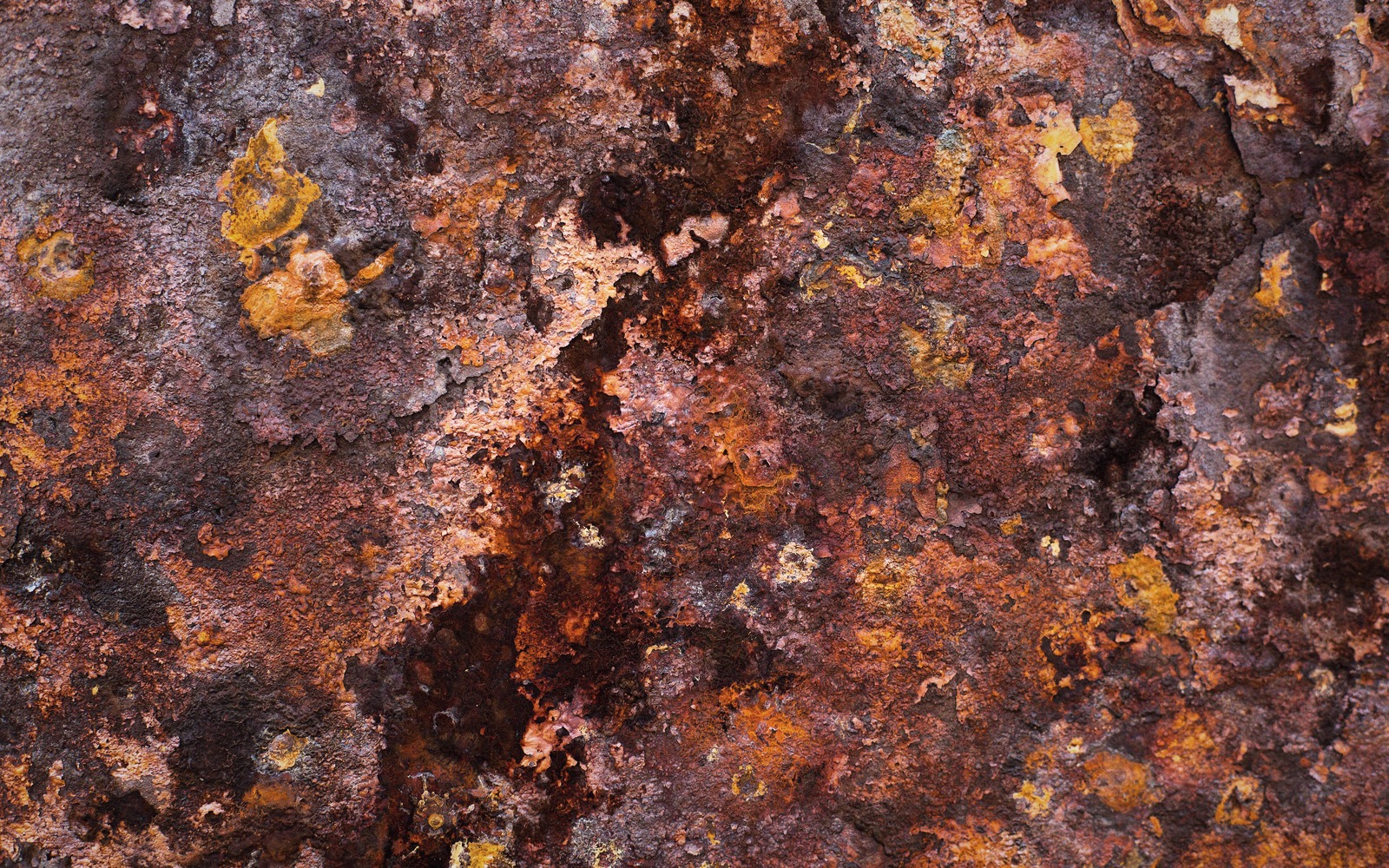
Rust has a reputation problem. It looks passive — a surface quietly giving up, a gradual surrender to neglect — and that framing leads people to think of it as something that happens when maintenance stops. The reality is more active and more instructive. Corrosion is not a surface phenomenon. It is an electrochemical process, which means it has all the architecture of a circuit: an anode, a cathode, a conductor, and an electrolyte. Remove any one of those four, and the reaction stops. On a steel hull afloat in the Gulf of Mexico, all four are present in abundance, which is why corrosion does not need any help and cannot be wished away.
The anode is where metal is lost. At anodic sites, iron atoms give up electrons and enter solution as ions — which is to say, the metal dissolves. Those electrons travel through the steel itself to cathodic sites, where they are consumed in a reduction reaction, typically involving dissolved oxygen in the water. The ionic current — the other half of the circuit — flows through the electrolyte: in this case, salt water, which is an exceptionally conductive medium because of its dissolved sodium chloride. The metal at the anode is consumed; the metal at the cathode is not. The overall result is the conversion of iron into iron oxides and hydroxides — the compound we call rust — and an irreversible loss of section.
What drives the anode-cathode distinction? Difference in electrical potential. And here is the thing about steel: it is not a uniform material. It has grain boundaries, inclusions, regions of different stress, areas where the surface chemistry differs because of mechanical working or heat exposure. Any two points on the same piece of steel can sit at measurably different electrochemical potentials, and wherever that potential difference exists, the more active site becomes anodic and begins to be consumed. This is why perfectly homogeneous metal in perfectly pure water corrodes far less aggressively than real steel in real sea water. The impurities and the geometry are the problem, and USS Texas carries both in extraordinary density.
Key facts · terms used on this page
Plate 03- anode
- electrode where metal is lost; oxidation occurs here
- cathode
- electrode where reduction occurs; metal is not consumed
- electrolyte
- conductive medium (here, salt water) carrying ionic current
- galvanic corrosion
- accelerated attack on less-noble metal in contact with a more-noble metal
- crevice corrosion
- localised attack in confined geometry caused by differential oxygen concentration
- galvanic series
- ordered ranking of metals by electrochemical potential in a given electrolyte
02What a Riveted Hull Gives the Circuit
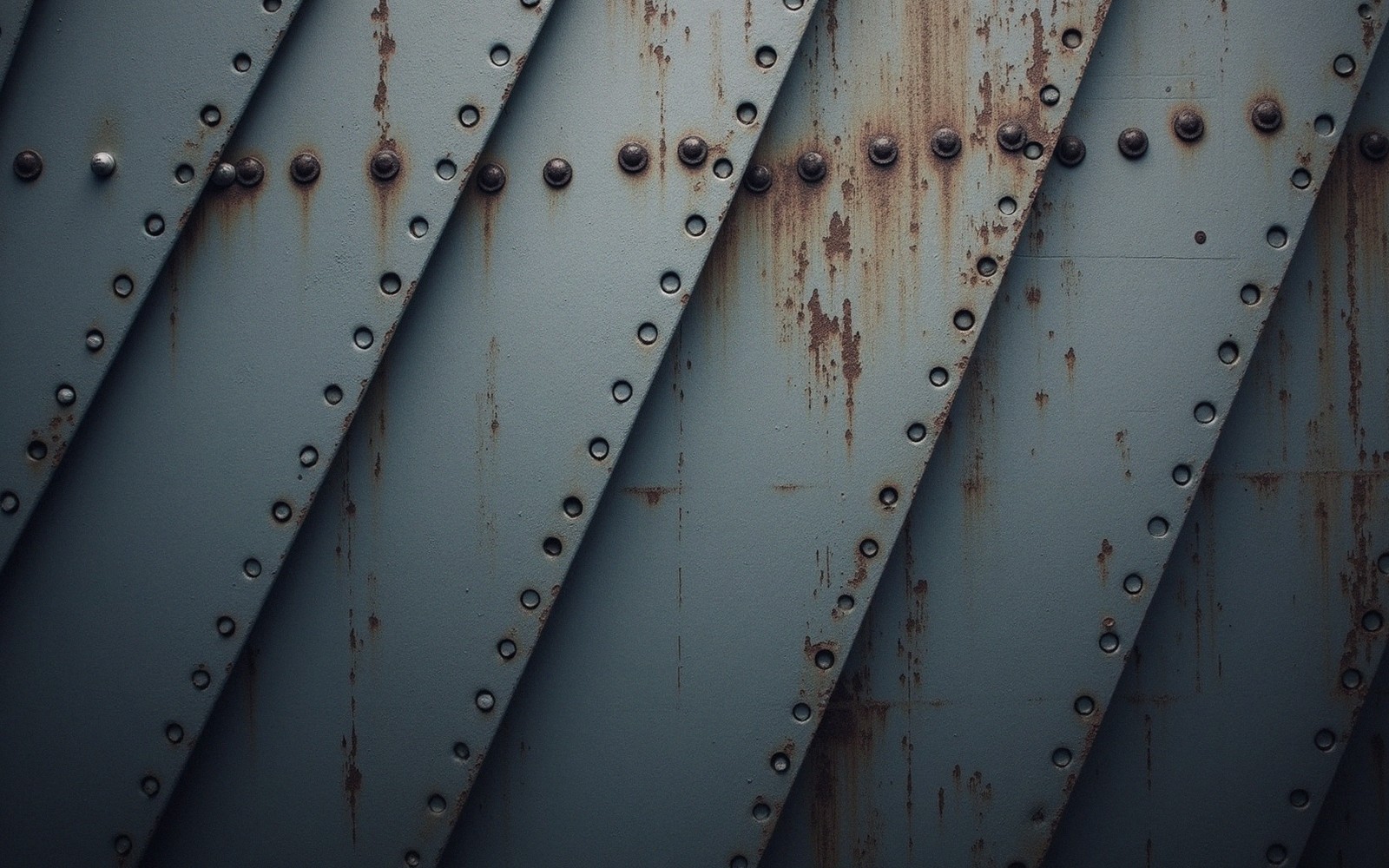
A riveted ship is not one material. It is an assembly of mild steel plates fastened with wrought-iron rivets through overlapping seams, set in place over a century ago, with every joint representing a local change in chemistry, geometry, and stress. That description is also, from the corrosion engineer's point of view, a description of an exceptionally well-configured galvanic cell.
Galvanic corrosion is what happens when two dissimilar metals are in electrical contact through an electrolyte. Each metal has a characteristic position on what engineers call the galvanic series — an ordering of metals and alloys by their electrochemical nobility. The more active (less noble) metal becomes the anode and is preferentially attacked; the more noble metal is protected at the active metal's expense. Wrought-iron rivets sitting in mild-steel plate are not dramatically different in the galvanic series, but they are measurably different, and in salt water with a century to work in, measurably different is more than enough. The rivet, or the plate immediately around it, corrodes preferentially. The crevice geometry of the overlapping seam makes it worse.
At anodic sites, iron atoms give up electrons and enter solution as ions — which is to say, the metal dissolves.
Crevice corrosion is a specific and particularly vicious mechanism. Within a tight seam — plate lapping plate, millimetres of separation — the electrolyte becomes locally depleted of oxygen. The cathodic reaction that consumes oxygen cannot proceed at the same rate inside the crevice as it can outside. What results is an electrochemical differential between the anoxic interior and the oxygenated exterior: the interior becomes anodic. Crevice geometry is, in other words, a self-organising corrosion machine. It concentrates the attack exactly where the joint is. And riveted construction, with its hundreds of thousands of rivets and miles of seams, provides that geometry on an industrial scale. The riveted hull that made USS Texas watertight when she was launched is also the feature that makes her hardest to protect.
Temperature compounds everything. The Gulf of Mexico is warm, and warm water holds less dissolved oxygen than cold water but is a better ionic conductor and supports higher reaction rates. The electrochemistry accelerates. Biological fouling — the films of bacteria, the barnacles, the tube worms — creates further differential aeration cells beneath the mat, running the same crevice-corrosion mechanism at a biological scale. A ship in warm coastal water is sitting in an environment almost perfectly calibrated to maximise the rate at which steel becomes rust.
1914year USS Texas was commissioned
1925–1927years of refit during which blisters were added to hull
03Differential, Depth, and What Gets Hidden
Corrosion on a hull is not uniform. That would almost be preferable, because uniform thinning at a known rate could be predicted and managed. What actually happens is localised attack — pitting in particular — driven by the local variations in chemistry and geometry described above. A pit that starts as a small anodic site develops its own internal chemistry as it deepens: the confined geometry inside the pit replicates the crevice effect, the local environment becomes acidic, and the rate of attack accelerates with depth. Pitting can perforate steel of significant original thickness while leaving the surrounding area superficially sound. From the outside, the plate looks intact. From the inside, it is a wall of craters, some of which reach through.
This is the particular horror of a hull that cannot be regularly drydocked and inspected. The damage is not announced; it accumulates invisibly, on the wetted interior surface of hull plating that cannot be accessed without pumping down ballast tanks or removing ceiling (the interior structural lining). By the time pitting is visible from a position accessible to a human being with a torch, it has already been working for years. The ship is not failing at the moment you see it failing. She failed earlier, quietly, inside a seam or beneath a stiffener where the geometry was perfect and the inspection was impossible.
The structure of Texas adds further complexity. The blisters added in her 1925–1927 refit created a second hull layer that changed the loading on the original plating while also creating enclosed voids — volumes of trapped, stagnant, poorly ventilated space. Voids breed differential aeration. The original hull plating, now sitting behind a blister it was never designed to be adjacent to, corrodes in an environment even less accessible than the original outer bottom. The blister protects against torpedo damage; it does not protect against electrochemistry. If anything, it gives the circuit somewhere to work undisturbed.
Chronology · stated as record
- 1914USS Texas commissioned; riveted mild-steel hull enters service
- 1925–1927blister refit adds second hull layer, creating enclosed voids
| Part | What it does |
|---|---|
| Electrolyte | Saltwater. It closes the circuit that makes corrosion possible at all. |
| Anode | The steel that gives up metal. On a riveted hull it is rarely the part you would choose. |
| Cathode | The steel that does not. Dissimilar metals and coatings decide which is which. |
| Geometry | A riveted lap holds a thin film of water where it cannot dry. The seam is the vulnerability. |
| Time | A century of cycles. Nothing here is fast; all of it is cumulative. |
04Fighting the Circuit, Practically
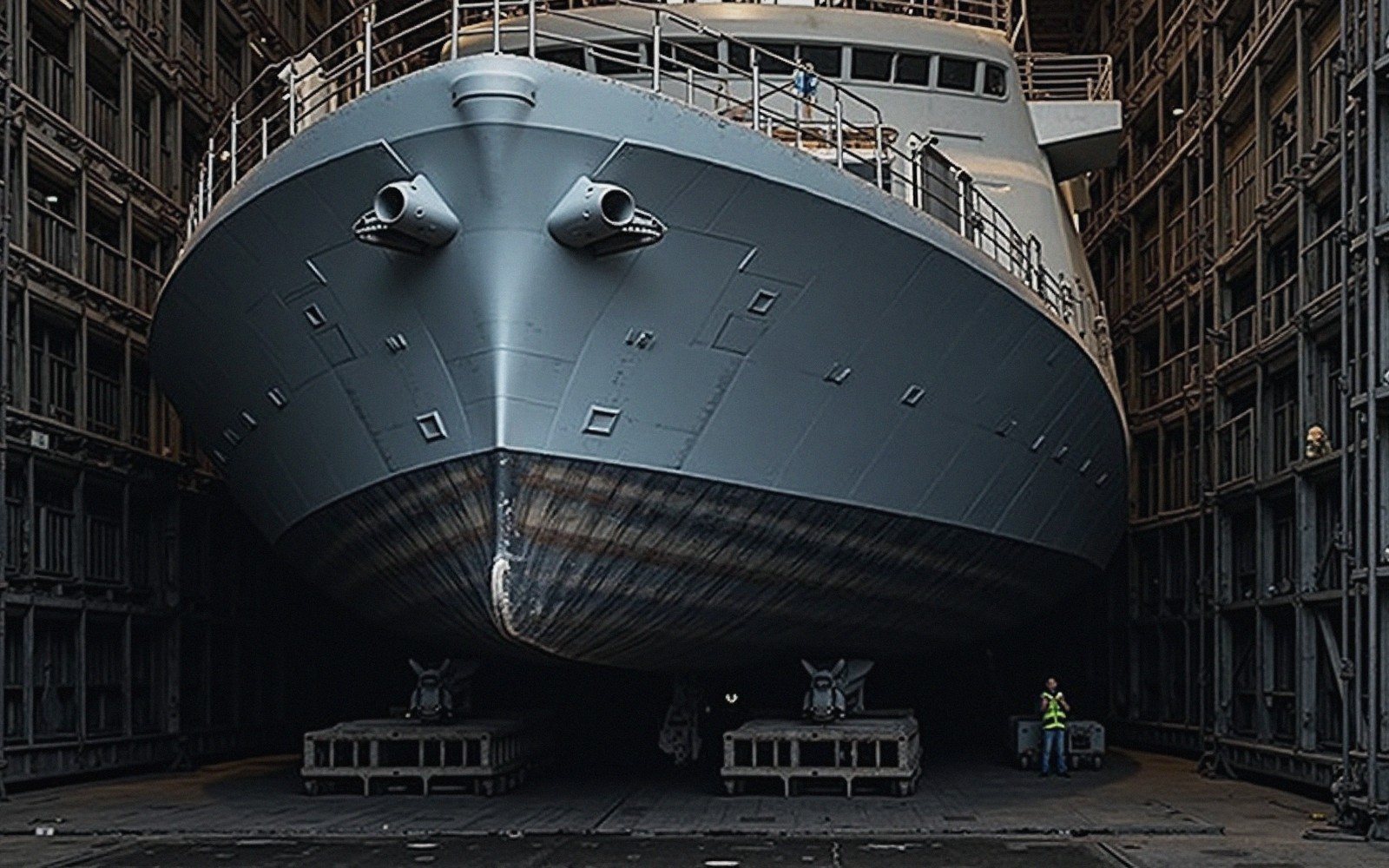
There are four tools for managing hull corrosion on a ship that cannot be continuously drydocked: coatings, cathodic protection, dehumidification, and inspection. None of them stops the electrochemical process; they interrupt it, slow it, or detect it before it reaches critical.
Coatings work by removing the electrolyte from contact with the metal — no electrolyte, no ionic current, circuit broken. The difficulty is that coatings fail. They blister, crack, disbond at edges and at any penetration, and once a coating fails locally, the exposed metal beneath it can become anodic while the surrounding coated area acts cathodically — a large cathode driving a small anode, which concentrates the attack and accelerates it dramatically. A badly applied or partially failed coating can be worse than no coating at all.
Cathodic protection imposes a current that makes the entire protected structure cathodic — it shifts the potential of the hull so that the hull metal no longer acts as an anode anywhere. Sacrificial anodes, typically zinc or aluminium, are attached to the hull and are deliberately allowed to corrode preferentially. Impressed-current systems pump electrical current into the structure from an external supply. Both approaches are well-established and effective, but both require maintenance, periodic replacement of consumed anodes, and regular verification that protection is actually being achieved across the whole surface. A sacrificial anode twenty metres from a critical location may not be providing meaningful protection at that location if the resistance path through the water is high enough.
Dehumidification works on enclosed internal spaces — voids, tanks, compartments that can be sealed — by removing the moisture from the air, thereby reducing the atmospheric corrosion rate on internal surfaces not in contact with free water. It does not address the wetted external hull.
Inspection, finally, is not a remedy but a prerequisite for everything else. You cannot treat what you have not found, and finding it on a hull of Texas's age, construction, and complexity requires ultrasonic thickness gauging at representative points across the entire wetted surface, regular enough that the rate of change can be tracked rather than just a single data point obtained. This is the information that decides where plate renewal is necessary, where cathodic protection is failing, and where the remaining life of a given section can be measured in years rather than decades. Inspection does not slow corrosion. It is what allows every other intervention to be targeted where it is actually needed.
Written from published engineering and heritage sources. Where a figure is not documented, this archive describes the engineering rather than asserting a number.
| Aspect | Coatings | Cathodic protection |
|---|---|---|
| Mechanism | Keeps the electrolyte off the metal | Makes the whole hull cathodic, so it stops giving up metal |
| Fails by | Blistering and disbonding — a small bare anode driven by a large cathode | Anodes being consumed, or protection not reaching a given area |
| Upkeep | Surface preparation and recoating cycles | Replacing anodes; verifying potentials across the surface |
| Limit | Only protects steel that is still there | Slows loss; does not restore section |
Subjects and places referred to
USS Texas (BB-35)
Referred to on this page
New York-class dreadnought battleship, subject of ongoing preservation
Galveston
Referred to on this page
location associated with Texas's preservation and drydocking programme
Gulf of Mexico
Referred to on this page
warm, high-salinity operating environment accelerating corrosion rates